USS Rodney M. Davis (FFG-60): A Full History
The USS Rodney M. Davis (FFG-60) was a guided-missile frigate of the United States Navy, part of the Oliver Hazard Perry-class — a prolific class of warships built during the late Cold War. These frigates were designed as versatile surface combatants capable of anti-air, anti-surface, and anti-submarine warfare, while also being cost-effective and easily maintained.
Named in honor of Marine Sergeant Rodney Maxwell Davis, who was posthumously awarded the Medal of Honor for heroic action during the Vietnam War, the ship carried with it both a proud legacy and a dual mission: to defend U.S. interests and to honor the sacrifice of its namesake.
Construction and Commissioning
-
Keel Laid: 8 February 1985 at Todd Pacific Shipyards, San Pedro, CA.
-
Launched: 11 January 1986.
-
Commissioned: 9 May 1987 — entering active service with the U.S. Navy.
The ship’s early years saw it homeported in Long Beach, California, before moving to Yokosuka, Japan, where it was forward deployed with Destroyer Squadron 15 — reflecting the U.S. Navy’s strategic emphasis on presence in the Pacific. Later, its homeport shifted to Naval Station Everett, Washington, where it remained for many years.
Capabilities and Role
As an Oliver Hazard Perry-class frigate, Rodney M. Davis was equipped with:
-
A 76 mm Mk 75 naval gun capable of rapid fire.
-
Anti-ship and surface warfare systems, including Harpoon missile launchers and torpedo tubes.
-
AN/SPS air and surface search radars and sonar suites for anti-submarine operations.
-
Two SH-60 LAMPS III helicopters, which extended its sensor range and engagement envelope.
These features made her a multi-mission warship — capable of escorting larger vessels, conducting patrols, and participating in multinational operations.
Operational Career and Achievements
During her nearly three decades of service, USS Rodney M. Davis participated in a wide range of missions:
Counter-Narcotics Operations
One of her most notable early achievements was in April 2001, when she and a U.S. Coast Guard Law Enforcement Detachment intercepted a fishing vessel in the Pacific Ocean carrying an enormous 26,931 lb (≈12,215 kg) cocaine shipment — one of the largest maritime drug seizures in history.
She continued counter-drug deployments throughout the Caribbean and the Eastern Pacific, seizing significant quantities of illegal narcotics and disrupting trafficking networks.
Regional Presence and Exercises
Rodney M. Davis also took part in numerous bilateral and multinational exercises, especially around the Indo-Asia-Pacific region — working with allied navies, conducting training exchanges, and building naval cooperation.
These deployments spanned everything from port visits and humanitarian engagements to formal training evolutions with other navies — reinforcing diplomatic and defense ties.
End of Active Service
After 28 years of active duty, USS Rodney M. Davis was decommissioned on 23 January 2015 at Naval Station Everett, Washington. At that ceremony, sailors, officers, and veterans celebrated her long and distinguished service.
Following her decommissioning, she was struck from the Naval Vessel Register on 31 March 2015 — formally ending her status as a Navy warship.
The Sinking: RIMPAC 2022 and SINKEX
Your question mentions “sunk after hit by…”, so it’s important to clarify exactly how she sank — and in what context.
Not in Combat — But in Exercise
USS Rodney M. Davis did not sink during combat. She was not destroyed in battle, nor was she involved in wartime damage. Instead, her sinking took place during a planned live-fire exercise intended to provide training to modern forces in realistic conditions.
This exercise was part of RIMPAC 2022 (Rim of the Pacific) — the world’s largest international maritime exercise — hosted by the United States in waters around Hawaii and the Pacific Ocean. The exercise brought together naval forces from more than two dozen nations and thousands of personnel.
SINKEX: How It Happened
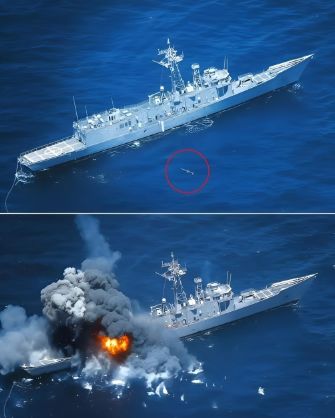
On 12 July 2022, Rodney M. Davis — long since retired and stripped of anything hazardous — was used as a target ship for a sinking exercise (SINKEX). These events are common for decommissioned vessels and are used to test weapons, tactics, and coordination in realistic scenarios.
Before being sunk, the ship underwent certified cleaning to remove all environmentally harmful materials — a requirement for sinking exercises.
Forces Involved
Ships and aircraft from four allied nations participated in the attack on the frigate:
-
The U.S. Navy, including surface ships and maritime patrol aircraft.
-
The Royal Canadian Navy, notably the Halifax-class frigate HMCS Winnipeg.
-
The Royal Australian Navy.
-
The Royal Malaysian Navy, whose corvette KD Lekir fired a French-made Exocet MM40 Block 2 anti-ship missile during the exercise.
Together, these forces launched a mix of anti-ship missiles (including U.S. Harpoon missiles and Malaysian Exocets) — and possibly bombs from aircraft — striking the old frigate.
The Sinking
The retired frigate was struck by multiple missiles and munitions over the course of the exercise. It withstood several hits thanks to its sturdy construction, sealed compartments, and the lack of fuel or ammunition aboard — but ultimately, after sustained attack and flooding, she sank into waters roughly 15,000 feet deep about 50 nautical miles north of the Hawaiian island of Kauai.
Why Use a Ship as a Target?
A SINKEX provides several key benefits to participating forces:
-
Live-fire training: Sailors and aviators practice targeting and weapons delivery under realistic conditions.
-
Tactics testing: Forces evaluate how weapons perform against real ship structures, refining warfighting tactics.
-
Coalition cooperation: Multiple nations coordinate complex operations, strengthening interoperability.
Legacy and Significance
The sinking of USS Rodney M. Davis was not a loss in battle, but rather a final contribution to U.S. and allied naval readiness. After decades of service — from real world patrols to historic drug seizures — the frigate’s hull served as a realistic target to help train the next generation of sailors and mariners.
Her end is symbolic: even in retirement, she provided value — training partners, testing weapons, and strengthening alliances.