The Body She Couldn’t Stop Seeing
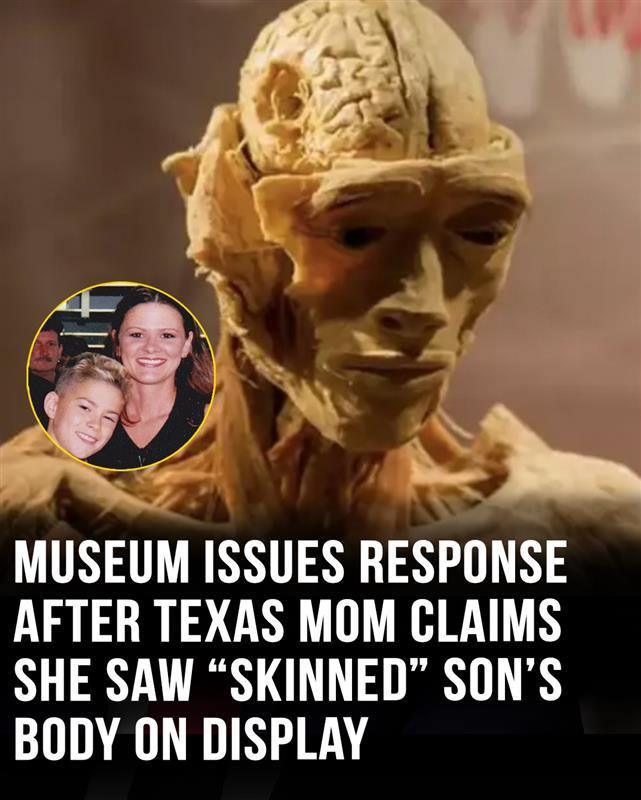
The Las Vegas Real Bodies exhibit was designed to educate — a gallery of preserved human forms displayed in bright clinical light. But for one Texas mother, it became a chamber of anguish. Where visitors saw anatomy, Kim Erick saw her son.
Her conviction wasn’t born in the museum that day. It had been forming for years, shaped by grief, doubt, and the quiet hum of questions that never found answers.
The Unquiet After Death
In 2012, Kim’s 23-year-old son, Chris Todd Erick, died suddenly. Police said an undiagnosed heart condition caused two cardiac arrests. His father and grandmother arranged a rapid cremation; Kim was handed a small necklace said to hold some of his ashes. Everything moved too quickly. Grief pressed her to accept what she couldn’t understand.
Then came the photographs — bruises on Chris’s arms, marks she couldn’t explain. A 2014 homicide review confirmed there was no foul play. Yet for Kim, evidence could not quiet instinct. Something in her mother’s heart stayed restless.
The Day the Exhibit Spoke
In 2018, Kim visited Real Bodies in Las Vegas. She wasn’t searching for anything — until she stopped before a figure called “The Thinker.”
The seated, skinless man seemed to look back at her. She noticed the skull fracture, the proportions of the limbs, even the curve of the hands. And where Chris once had a tattoo on his upper arm, she saw what looked like a deliberate patch of skin removed before preservation.
Shock gave way to certainty. To her, it wasn’t resemblance — it was recognition.
Paperwork vs. Mother’s Intuition
She demanded DNA testing. The exhibit’s organizers declined, producing documents showing the body had been plastinated in 2004 — eight years before Chris’s death — and legally sourced from China. The timeline, they said, made her claim impossible.
But then, months later, “The Thinker” was quietly removed from display. No announcement. No reason given. For Kim, the silence spoke louder than any official denial.
Authorities still maintain their records are accurate. To them, this is a closed case. To Kim, closure is precisely what has been denied.
Love That Refuses the File-Cabinet Ending
Her belief has long outlived the investigations. She keeps searching, writing, asking, hoping. Because while institutions trust documentation, a mother’s certainty rises from another place — that hidden faculty where memory, love, and pain converge into something stronger than logic.
Whether she is right or wrong may never be proven. But her persistence reveals a truth deeper than the mystery itself: that when love is stripped of form, it does not vanish. It lingers — raw, searching, and unburied — in the space between what is known and what the heart refuses to release.