

Doña Elena lived in a humble thatched hut on the banks of the Papaloapan River in Veracruz, where the nights were filled with crickets and the murmur of the water. At 73, she still rose before dawn to water her small garden of chilies and tomatoes and feed the few chickens she had left. Her life was simple and solitary, but imbued with memories that kept her alive.
Her husband, Don Mateo, had died decades ago, and her only son, Diego, was all she had in the world. He had been a bright, hardworking child, the pride of the entire town. When he went to Mexico City on a university scholarship, everyone said the boy would go far. He went so far, he got lost.
For ten long years, Doña Elena received only the occasional call at Christmas, and the odd deposit that she rarely touched. She knew the rest from town gossip:
“They say Diego’s a businessman now, did you know?”
“He lives in a huge house, one of those you see in magazines.”
“He drives brand-new cars, imagine!”
Doña Elena would smile and always reply the same:
“That’s enough for me. Take care.”
But every night, before turning off her oil lamp, she would take the old photograph of Diego when he was eight years old, covered in mud but smiling, and kiss it affectionately.
One day, as a light drizzle fell on the fields, a black car—a huge SUV, gleaming like an urban beast—pulled up in front of the shack. Diego got out, unrecognizable: Italian suit, watch worth more than the entire orchard, and his hair perfectly styled. But his eyes…
His eyes were lifeless.
“Mom,” he said, his voice breaking, as he knelt before her. “Forgive me. I shouldn’t have left you here. I want to take you to live with me. In my house. It’s big, comfortable… you deserve to rest.”
Doña Elena felt tears streaming down her face, unstoppable.
“Oh, son… I never asked you for anything…”
“That’s exactly why, Mama,” he said, taking her hands. “Let’s go today. Now!”
Diego insisted so much that she agreed. She gathered three changes of clothes, the old photograph, and a small wooden box containing her husband’s last letters.
During the trip to Mexico City, Doña Elena looked out the window like a lost child: lights, tall buildings, constant noise… a world that seemed more alien to her than ever.
Diego’s house in Polanco was a monstrous display of luxury: eight floors, endless windows, and a foyer that looked like it belonged in a museum. But the luxury didn’t impress Doña Elena as much as the cold gaze of Mariana, her daughter-in-law.
Tall, elegant, perfectly made up… but with an expression that revealed nothing.
No joy.
No welcome.
Barely an uneasy tolerance.
The first dinner was an interminable silence. Mariana barely looked up from her phone. Diego talked about contracts, clients, trips, but every time his wife glanced at him, he fell silent.
There was something strange. Something sinister.
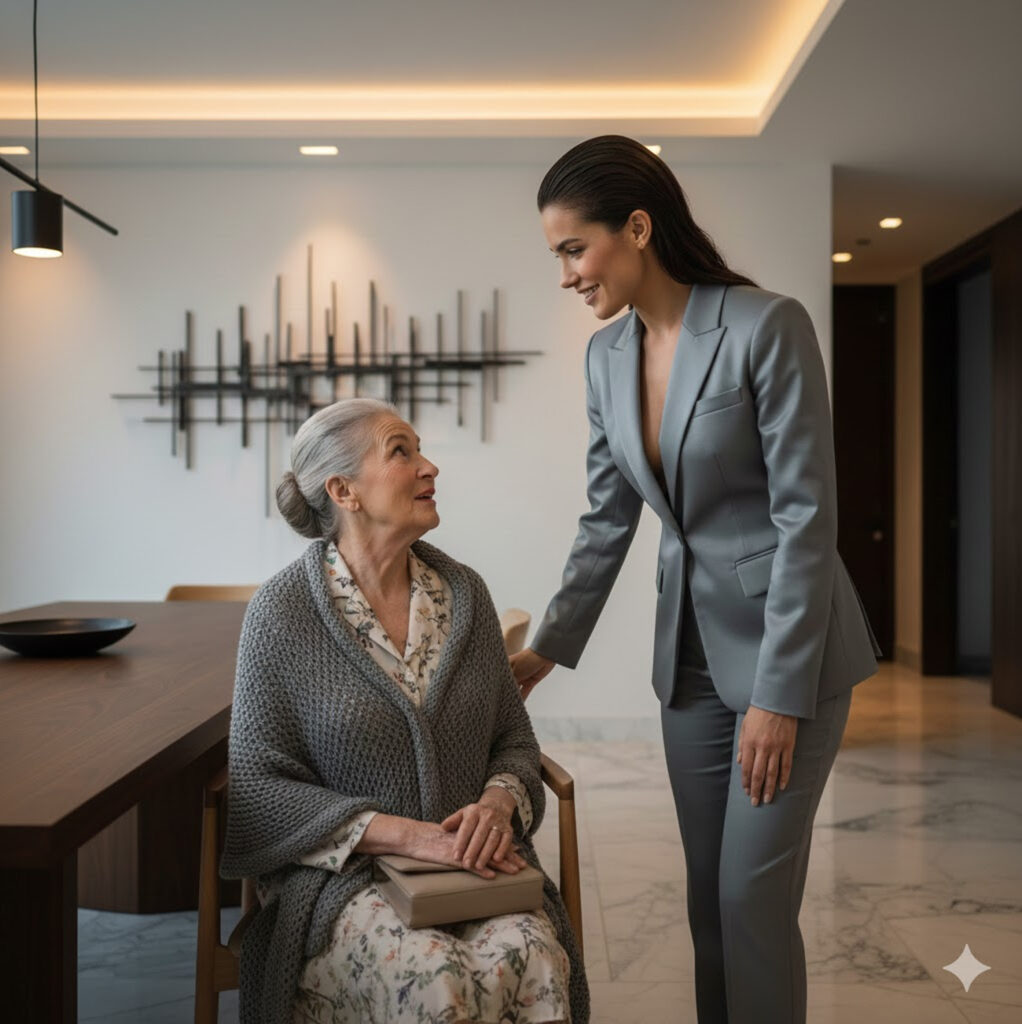
Doña Elena began to feel a knot in her stomach.
This was not the Diego she had raised.
After dinner, while Diego was on an “emergency” video call, Mariana approached unexpectedly. She walked with soft, measured steps, like a panther in a luxurious ballroom. She stopped right in front of Doña Elena.
Her face, illuminated by the warm lights of the dining room, was beautiful.
But her voice…
Her voice was like sharp ice.
“Excuse me, Mrs. Elena…” he said with a smile so fake it hurt to see it. “I need to ask you something.”
Doña Elena, naive, smiled back.
“Of course, daughter. Tell me.”
Mariana tilted her head, as if she were inspecting defective merchandise. Then, in a perfectly neutral tone, she said:
Doña Elena felt a blow to her chest.
It wasn’t a question.
It was a sentence.
Mariana continued mercilessly:
“Diego can’t take on any more expenses. He already has enough to deal with. I just want to know how long he plans to stay… so we can make arrangements.”
The final word — to organize ourselves — fell like poison.
As if the presence of an elderly mother were a logistical problem.
A hindrance.
And then, Doña Elena understood something terrible:
She hadn’t been invited to live there.
She had been tolerated.
Barely.
Diego, her boy, the same child who used to run barefoot through the fields… was being controlled, pressured, perhaps even manipulated. She saw it in his eyes during dinner.
He wanted her close.
But Mariana didn’t.
And in that house, it was obvious who was in control.
That night, Doña Elena didn’t sleep a wink.
She wandered through the enormous house: gleaming floors, modern art, cold statues… There was no life there.
No love.
Only appearances.
Only calculations.
When everything was quiet, she gathered her things. She put away the photo of Diego as a child. She stroked it for a moment. Then she wrote a note in the trembling handwriting of years past:
“Thank you, son, for remembering me.
Your house is beautiful, but it’s no home for an old woman like me.
I’m going back to where I’m free, where I can breathe.
To my little straw house, where I still know who I am.”
She opened the door carefully, as if afraid of waking him.
She looked one last time at the enormous house.
And left.
Barefoot.
Alone.
But with a peace that no marble could give her.
At dawn, Diego found the note.
And something broke inside him.
He ran out into the street, desperate, calling for his mother like when he was a child.
But Doña Elena was already far away, heading towards the village, her head held high and her heart free.